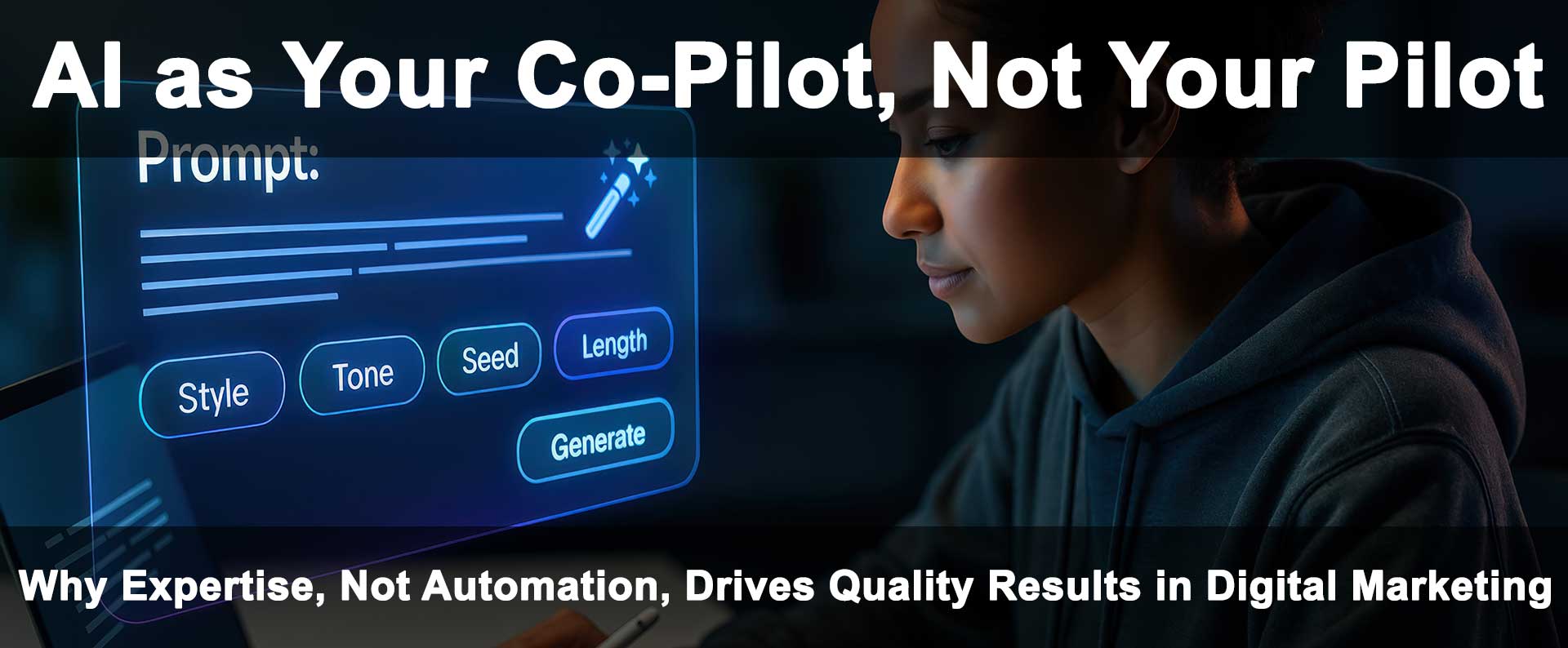
Why Expertise, Not Automation, Drives Quality Results in Digital Marketing
The advent of Artificial Intelligence (AI) has brought about a paradigm shift in numerous industries, and content creation is no exception. Its rise has sparked a crucial debate:
Is it a revolutionary tool for professionals or a looming replacement for human creativity and expertise?
For small and medium business owners and managers navigating the complex world of digital marketing, the answer lies not in choosing one over the other, but in understanding a vital distinction. While the buzz often revolves around AI's ability to "write," a more nuanced understanding reveals its true power lies as a sophisticated tool for professionals—enhancing rather than replacing human expertise.
At its core, AI content generation, particularly with large language models, is a sophisticated pattern recognition and prediction engine. It doesn't inherently "understand" in the human sense.
To produce truly valuable and accurate content, AI requires precise guidance—a task that can only be effectively performed by a professional already knowledgeable in the subject matter.
A user lacking intrinsic knowledge of the topic will inevitably struggle to craft prompts that elicit proper, informative, and contextually relevant content.
Consider the analogy of a master craftsman and their tools. A skilled carpenter can use a power saw to quickly and accurately cut intricate designs, but the saw itself doesn't possess the knowledge of joinery or aesthetic principles. Similarly, an AI content generator is a powerful tool in the hands of a knowledgeable professional.
The user must know the topic, understanding its nuances, jargon, and target audience, to provide the proper prompts. These prompts act as the blueprint, defining the scope, tone, key talking points, and desired outcome.
Without this informed guidance, the AI will merely generate generic, potentially inaccurate, or superficial content, failing to meet professional standards.
Understanding the Core Distinction: Tool vs. Replacement
A replacement implies that the AI operates independently, making strategic decisions and producing final, publish-ready work. A tool, however, is wielded by a skilled professional to enhance their capabilities, streamline tedious processes, and amplify their expertise.
AI, in its current state, is a sophisticated pattern-matching engine that analyzes vast amounts of existing text to predict and generate statistically probable sequences of words.
It lacks true understanding, intent, or the ability to formulate original strategic ideas. Therefore, the quality of its output is directly and irreversibly tied to the quality of its input—the prompt.
- Expertise Matters:
To fully leverage AI content generation, a user needs to possess a substantial understanding of the topic at hand.
Someone skilled in hospitality, for instance, can prompt AI with specific details that lead to rich and meaningful content.
An uneducated user may struggle to provide effective prompts, leading to subpar results.
- Effective Prompting:
Creating insightful and informative prompts is critical.
For example, a restaurant owner looking to highlight seasonal menus must know current trends and consumer preferences to guide the AI effectively.
A knowledgeable prompt like “Generate social media posts that emphasize our new farm-to-table menu, catering to health-conscious diners” is far more effective than simply asking for content about a restaurant.
The Professional’s Role: Knowledge as the Foundation
AI content generation doesn’t start with a machine—it starts with a human. A professional who is deeply knowledgeable about a topic, industry, or audience is the irreplaceable foundation. Think of AI as a sophisticated assistant: it can draft, suggest, and organize, but it cannot originate insight, strategy, or nuanced understanding.
For example, an experienced marketer in the healthcare sector knows strict compliance guidelines (like HIPAA in the U.S.), the sensitive nature of patient communication, and the technical terminology that builds trust. An AI tool, without precise guidance, might generate content that is legally risky or tonally inappropriate.
This leads to the critical skill of prompt engineering—crafting detailed, context-rich instructions for the AI. This is not a matter of simple typing; it requires deep subject-matter expertise.
An uneducated user might ask an AI:
"Write a blog about construction."
A knowledgeable professional would prompt:
"Act as a marketing expert for a residential remodeling contractor in [City]. Write a 700-word blog post targeting homeowners aged 35-55, addressing common concerns about kitchen renovation ROI. The tone should be trustworthy and informative.
Include sections on:
1) The average cost vs. value report data for mid-range kitchen remodels in our region,
2) Three design trends that maximize both functionality and resale value,
3) A breakdown of our project timeline to set client expectations.
Include a soft call-to-action offering a free design consultation."
The second prompt yields useful, targeted, and accurate content because the professional provided the strategic framework, key talking points, audience targeting, and factual anchors. The AI then assembles the prose around this expert skeleton.
Without intrinsic knowledge of the industry, customer pain points, and factual data, the AI’s output would be generic, potentially inaccurate, and useless for driving business.
-
Creativity & Insight:
Experienced writers infuse creativity, emotional insight, and a unique voice into their work, which AI struggles to replicate fully.
For instance, a healthcare professional crafting a patient story can evoke empathy and provide real-life context that resonates more deeply than generated content.
- Quality Control:
AI-generated content often requires human oversight to ensure it meets industry standards.
An educated writer can refine AI output, fact-check information, and adapt it for the intended audience. In legal services, where precision is paramount, this aspect cannot be understated.
- Industry-Specific Expertise:
Each industry has its terminologies and expectations.
In construction, for example, integrating terms like "lean construction" or "BIM" (Building Information Modeling) requires a writer’s intimate understanding of these concepts, ensuring the content remains relevant and authoritative.
AI as a Force Multiplier, Not a Replacement
The fear that AI will replace writers, designers, and marketers is misguided; instead, it replaces tasks—not roles. It automates the tedious first draft, the generation of meta-descriptions for 100 product pages, or the brainstorming of social media post ideas for a quarterly calendar.
This frees the professional to focus on high-value activities: strategy, editing for brand voice, fact-checking, and creative direction.
For SMBs, this tool becomes a force multiplier within an existing marketing strategy. It doesn’t replace your website, SEO, social media, or email campaigns; it supercharges your ability to maintain them consistently with quality.
1. Content Scaling for SEO & Authority:
A healthcare clinic knows that publishing regular, informative articles builds authority and improves search engine rankings.
- The doctor provides the key medical points, dietary advice, and new treatment options.
- The marketing professional crafts a detailed prompt, and the AI generates a well-structured first draft.
- The doctor then reviews for medical accuracy, and the editor polishes for voice.
- This process cuts drafting time significantly, allowing for more frequent, high-quality content publication.
2. Reinforcing Multi-Channel Campaigns:
A restaurant launching a seasonal menu can use AI efficiently. The chef provides details on the new dishes, sourcing, and flavor profiles. Using this, AI can generate consistent copy for:
- Social media captions highlighting each dish.
- Email newsletter copy announcing the launch.
- Website blog post telling the story behind the seasonal ingredients.
- Ad copy variations for Facebook and Google Ads.
3. Tracking Outcomes with Integrated Funneling:
The true test is in conversion. Using CRM and marketing automation platforms, businesses can track how AI-assisted content performs.
For example, a law firm uses AI (guided by a lawyer) to create a series of articles on "estate planning for small business owners."
- These articles are gated behind a form on their website, becoming a lead generation tool.
- The firm can then track how many leads from this specific content series move through the sales funnel to become clients, measuring the ROI of the time saved.
The Ideal Use Cases for AI Content Generation
When utilized correctly, AI can be a significant ally in enhancing existing marketing strategies. Here are some actionable uses for businesses across industries:
Retail
- Product Descriptions:
Use AI to generate engaging product descriptions that highlight key features and benefits. Incorporate customer feedback and market trends into prompts.
- Social Media Content:
Automate repetitive social media posts while maintaining a human touch. Schedule engaging promotions based on seasonal trends and customer interactions.
Restaurants
- Social & Menu Content:
Generate weekly social media content calendars. Input the week’s specials, events, and a brand tone guide. AI can suggest daily post ideas.
- Newsletter Content:
Use AI to draft weekly email newsletters promoting specials. The chef or manager provides the menu items and a storytelling hook; the AI structures the email.
- Review Responses:
Train AI to draft appropriate, on-brand responses to customer reviews, enhancing engagement.
Hospitality (Hotels/B&Bs/Resorts)
- Website Content:
Implement AI to generate blog posts that feature local attractions or “insider tips” to enrich the guest experience.
- Guest Collateral Content:
Create personalized, templated email sequences for guest journeys (pre-arrival, welcome, post-departure). AI writes the drafts, staff personalizes with specific details.
Construction (Contractors, Trades)
- Project Updates:
Utilize AI to create concise and clear project updates for stakeholders, keeping everyone informed without overwhelming jargon.
- Case Study Content:
Develop detailed case study outlines from project notes. The project manager provides data points; AI structures this into a compelling narrative draft.
Healthcare (Private Practices)
- Patient Education:
Draft clear, readable patient education materials. A practitioner outlines key facts; AI creates a first draft that the practitioner finalizes for accuracy and compassion.
- Social Media Campaigns:
By understanding current health trends, AI can assist in formulating campaigns that resonate with patients.
Professional Services (Legal, Accounting)
- Content for SEO:
Use AI to generate informative articles based on trending legal or tax questions, helping to attract potential clients searching for answers.
- Newsletters:
Create comprehensive newsletters that summarize legislative changes or tax updates, showcasing expertise to clients.
Integration into a Holistic Marketing Strategy
AI-generated content shouldn’t exist in a vacuum. Its true power is unlocked when integrated into a holistic marketing strategy.
1. Content Repurposing:
A professionally guided AI can help turn a core whitepaper into a series of blog posts, social media snippets, and newsletter highlights, ensuring message consistency.
2. Reinforcing Traditional Channels:
AI can help swiftly generate copy for OOH billboard concepts or print brochure sections based on a core campaign theme developed by humans.
3. Funneling & Tracking:
Use marketing automation and CRM tools to track how AI-assisted content performs. By tracking engagement through to conversion, you measure the tool’s effectiveness and refine your strategy accordingly. This closed-loop process turns content creation into a data-informed activity.
Conclusion: The Synergy of Human and Machine
AI content generation is not about eliminating the writer, the marketer, or the expert. It’s about eliminating the drudgery of starting from zero. It is the modern equivalent of a power tool for a carpenter—it doesn’t build the house by itself, but it allows the skilled craftsman to work with greater precision, efficiency, and scale.
For SMBs across all industries, the winning strategy is to leverage AI as a co-pilot, guided by the steady hand of professional expertise. This synergy saves valuable time, enhances content quality and consistency, and ultimately allows businesses to focus their human intelligence on strategy, relationship-building, and closing the deal.